SEIR Epidemic: Difference between revisions
RobertLampel (talk | contribs) Created page with "{{Dimensions |nd = 1 |nx = 4 |nw = 1 }} The '''SEIR epidemic optimal control problem''' is a classical benchmark in mathematical epidemiology and optimal control of biological systems. This description is taken from [1]. It models the spread of an infectious disease through a homogeneous population divided into four compartments: susceptible (<math>S</math>), exposed (<math>E</math>), infectious (<math>I</math>), and recovered (<math>R..." |
RobertLampel (talk | contribs) |
||
| Line 80: | Line 80: | ||
[[Category:MIOCP]] | |||
[[Category:ODE model]] | [[Category:ODE model]] | ||
[[Category:Epidemiological model]] | [[Category:Epidemiological model]] | ||
[[Category:Biological systems]] | [[Category:Biological systems]] | ||
Revision as of 11:49, 3 September 2026
| SEIR Epidemic | |
|---|---|
| State dimension: | 1 |
| Differential states: | 4 |
| Discrete control functions: | 1 |
The SEIR epidemic optimal control problem is a classical benchmark in mathematical epidemiology and optimal control of biological systems. This description is taken from [1].
It models the spread of an infectious disease through a homogeneous population divided into four compartments: susceptible (), exposed (), infectious (), and recovered (). The control represents a time-varying vaccination (or isolation) rate applied to the susceptible compartment. The objective is to minimise a weighted combination of the cumulative infectious burden and the cost of the intervention over a finite horizon, yielding a trade-off between disease suppression and resource expenditure. The problem is nonlinear and non-convex, and typically admits a singular arc structure in the optimal control.
Mathematical formulation
where . All compartments are fractions of the total population, so for all . The term removes susceptible individuals through vaccination (or effective isolation), moving them directly to the recovered compartment at rate . The quadratic penalty models the increasing marginal cost of intervention.
Parameters
These fixed values are used within the model:
| Symbol | Value | Description |
|---|---|---|
| 0.5 | Transmission rate (day−1) | |
| 0.2 | Progression rate from exposed to infectious (day−1) | |
| 0.1 | Recovery rate (day−1) | |
| 0.5 | Weight on infection burden vs. control cost | |
| 0.5 | Maximum vaccination/isolation rate (day−1) | |
| 0.99 | Initial susceptible fraction | |
| 0.01 | Initial exposed fraction | |
| 0 | Initial infectious fraction | |
| 0 | Initial recovered fraction | |
| 100 | Horizon of the control problem (days) |
Reference Solutions
Here is one local solution to the above control problem.
- Reference solution plots
-
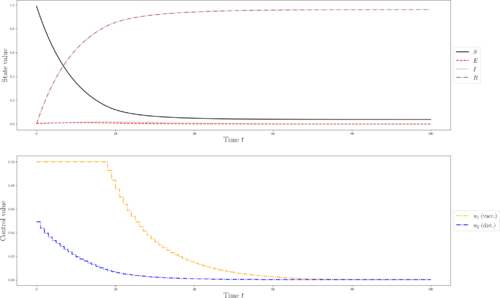 Compartment trajectories and optimal vaccination rate for a reference solution.

Miscellaneous and Further Reading
The basic reproduction number for the uncontrolled SEIR model is . With the parameters above, , corresponding to a highly transmissible pathogen. The optimal control problem was studied in detail by Lenhart and Workman [2], where necessary conditions via Pontryagin's minimum principle are derived and adjoint equations are solved numerically. This formulation and further discussion can be found in [1] and [2].
References
[1] Caillau, J.-B., Cots, O., Gergaud, J., & Martinon, P. OptimalControlProblems.jl: a collection of optimal control problems with ODE's in Julia. https://github.com/control-toolbox/OptimalControlProblems.jl
[2] Lenhart, S., & Workman, J. T. (2007). Optimal Control Applied to Biological Models. CRC Press.