Ramsey Growth
| Ramsey Growth | |
|---|---|
| State dimension: | 1 |
| Differential states: | 1 |
| Discrete control functions: | 1 |
The Ramsey growth problem is a foundational benchmark in optimal control and macroeconomic theory. This description is taken from [1].
First formulated by Frank Ramsey in 1928 [2] and later extended by Cass [3] and Koopmans [4], the problem determines the socially optimal path of capital accumulation and consumption for a representative household economy. The single state is the capital stock per worker, and the single control is consumption per worker. Capital accumulates through production (described by a Cobb–Douglas function), net of depreciation and consumption. The objective is to maximise the present value of a stream of discounted utility of consumption over a finite horizon, which is equivalent to minimising its negative. The resulting optimal trajectories converge towards a steady-state balanced growth path, and the problem serves as a standard test for indirect shooting methods and continuation techniques in optimal control.
Mathematical formulation
where is capital per worker, is consumption per worker, is the Cobb–Douglas production function, and is the constant-relative-risk-aversion (CRRA) utility function. As , the CRRA utility converges to (logarithmic utility). The transversality condition at the terminal time is .
Parameters
These fixed values are used within the model:
| Symbol | Value | Description |
|---|---|---|
| 0.05 | Pure rate of time preference (discount rate) | |
| 1.5 | Inverse of the intertemporal elasticity of substitution | |
| 0.33 | Capital share in production (Cobb–Douglas exponent) | |
| 0.05 | Capital depreciation rate | |
| 0.01 | Population (labour) growth rate | |
| 1 | Total factor productivity | |
| 0.5 | Initial capital per worker | |
| 100 | Horizon of the control problem |
Reference Solutions
Here is one local solution to the above control problem.
- Reference solution plots
-
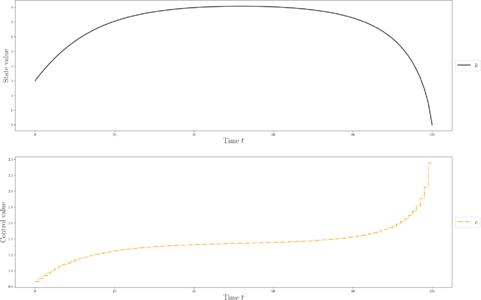 Optimal capital and consumption paths for a reference solution.

Miscellaneous and Further Reading
The steady-state capital stock satisfies (the modified golden rule). The optimal consumption path satisfies the Euler equation , known as the Keynes–Ramsey rule. The problem is solved analytically in the infinite-horizon limit and numerically for finite horizons using shooting or direct methods. This formulation and further discussion can be found in [1] and [2].
References
[1] Caillau, J.-B., Cots, O., Gergaud, J., & Martinon, P. OptimalControlProblems.jl: a collection of optimal control problems with ODE's in Julia. https://github.com/control-toolbox/OptimalControlProblems.jl
[2] Ramsey, F. P. (1928). A mathematical theory of saving. The Economic Journal, 38(152), 543–559.
[3] Cass, D. (1965). Optimum growth in an aggregative model of capital accumulation. The Review of Economic Studies, 32(3), 233–240.
[4] Koopmans, T. C. (1965). On the concept of optimal economic growth. The Econometric Approach to Development Planning. North-Holland.