Battery Storage
| Battery Storage | |
|---|---|
| State dimension: | 1 |
| Differential states: | 1 |
| Discrete control functions: | 2 |
The battery storage problem models the optimal operation of a grid-scale battery energy storage system (BESS) over a 24-hour scheduling horizon. The operator minimises total electricity cost given a fixed, time-varying demand profile and a time-of-use electricity price signal. Both signals are piecewise-constant, stepping every four hours through six daily blocks. The two non-negative controls represent charging power and discharging power separately, which avoids the need for integer variables while keeping the physics transparent. The optimal strategy is to charge during cheap night-time periods and discharge during expensive morning and evening peak periods, yielding an energy-arbitrage policy.
Mathematical formulation
where is the state of charge (SoC, dimensionless fraction of ), is the charging power (kW), is the discharging power (kW), and is the net power drawn from the grid. The cyclic boundary condition enforces a daily cycling constraint so the battery ends each day at the same charge level it started.
Price and demand profiles
Both and are piecewise-constant step functions defined on six consecutive 4-hour blocks:
| Block | Time interval (h) | (€/kWh) | (kW) |
|---|---|---|---|
| 1 | [0, 4) | 0.08 | 30 |
| 2 | [4, 8) | 0.20 | 60 |
| 3 | [8, 12) | 0.30 | 80 |
| 4 | [12, 16) | 0.15 | 50 |
| 5 | [16, 20) | 0.28 | 70 |
| 6 | [20, 24] | 0.10 | 35 |
The price pattern is cheap at night (blocks 1 and 6), expensive at the morning peak (block 3), and moderately expensive at the evening peak (block 5). The demand profile follows a corresponding load curve with low overnight consumption and a mid-morning peak.
Parameters
These fixed values are used within the model:
| Symbol | Value | Description |
|---|---|---|
| 200 kWh | Battery energy capacity | |
| 50 kW | Maximum charge / discharge power | |
| 0.95 | Charging efficiency | |
| 0.95 | Discharging efficiency | |
| 0.10 | Minimum state of charge | |
| 0.90 | Maximum state of charge | |
| 0.50 | Initial (and final) state of charge | |
| 24 h | Scheduling horizon |
Reference Solutions
Here is one local solution to the above control problem.
- Reference solution plots
-
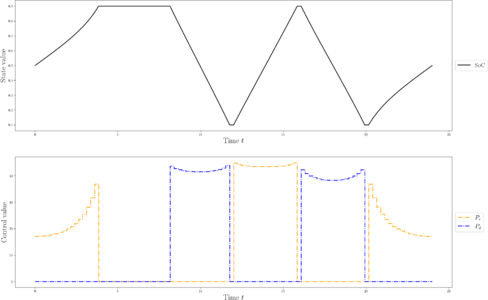 State of charge and optimal power schedule for a reference solution.

Miscellaneous and Further Reading
The battery storage optimal control problem arises in the operation of grid-scale energy storage, demand-response programs, and behind-the-meter storage systems. Formulating charging and discharging as two separate non-negative controls avoids the need for complementarity constraints or integer variables; the NLP relaxation is typically tight for cost profiles of this type because the optimizer has no incentive to charge and discharge simultaneously when round-trip efficiency is less than one. Numerical solutions generally exhibit a bang–bang structure in each control: the battery charges at full power during the cheapest blocks and discharges at full power during the most expensive blocks, with smooth transitions determined by the SoC bounds.
References
[1] Rahbar, N., Chai, C. C., & Zhang, R. (2015). Energy cooperation optimization in microgrids with renewable energy integration. IEEE Trans. Smart Grid, 6(3), 1482–1493.
[2] Nottrott, A., Kleissl, J., & Washom, B. (2013). Energy dispatch schedule optimization and cost benefit analysis for grid-connected, photovoltaic-battery storage systems. Renewable Energy, 55, 230–240.